CONCEPT DESIGN
The menu is in the wrong language.
A clinic service menu rebuilt around the concern a visitor can name, instead of the procedure they cannot.
Subject: Sadara Clinic, an invented dermatology and aesthetics clinic in Jumeirah, Dubai.
The brief we set ourselves.
A clinic's treatment menu is a list of procedure names. A visitor arrives with a concern. Someone who knows they have pigmentation does not know whether they need a peel, a laser, or neither, and an alphabetised list with price on request beside every line gives them nothing to decide with.
The usual fix is a longer menu and a better filter. Both help the person who already knows the word they are looking for, which is not the person who is stuck. This concept inverts the structure instead: the concern is the page, and the procedures sit underneath it.
The exercise changed no prices, no photography budget and no clinical copy. Only structure and hierarchy, because that is the part a real clinic can usually afford to change this quarter.
It is laid out as a stacked editorial spread, with the treatment room running full width across the middle of the page rather than boxed into a corner. This is a business sold on how calm the room feels, so the room belongs on the page at full size.
THE WORK
What the frames show.
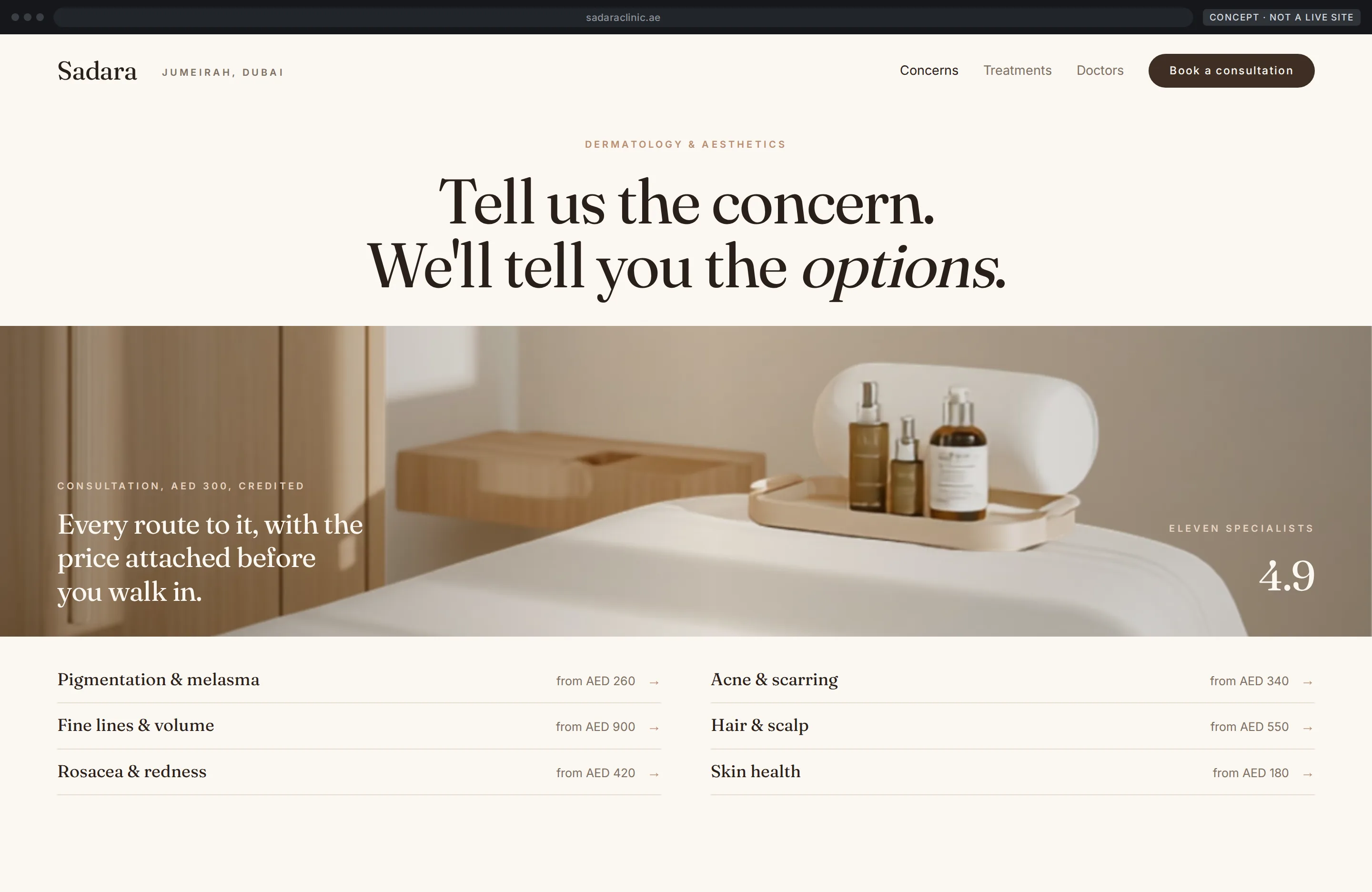
A quiet centred opening, then the treatment room full width across the middle of the page, then the six concerns beneath it with their real starting prices.
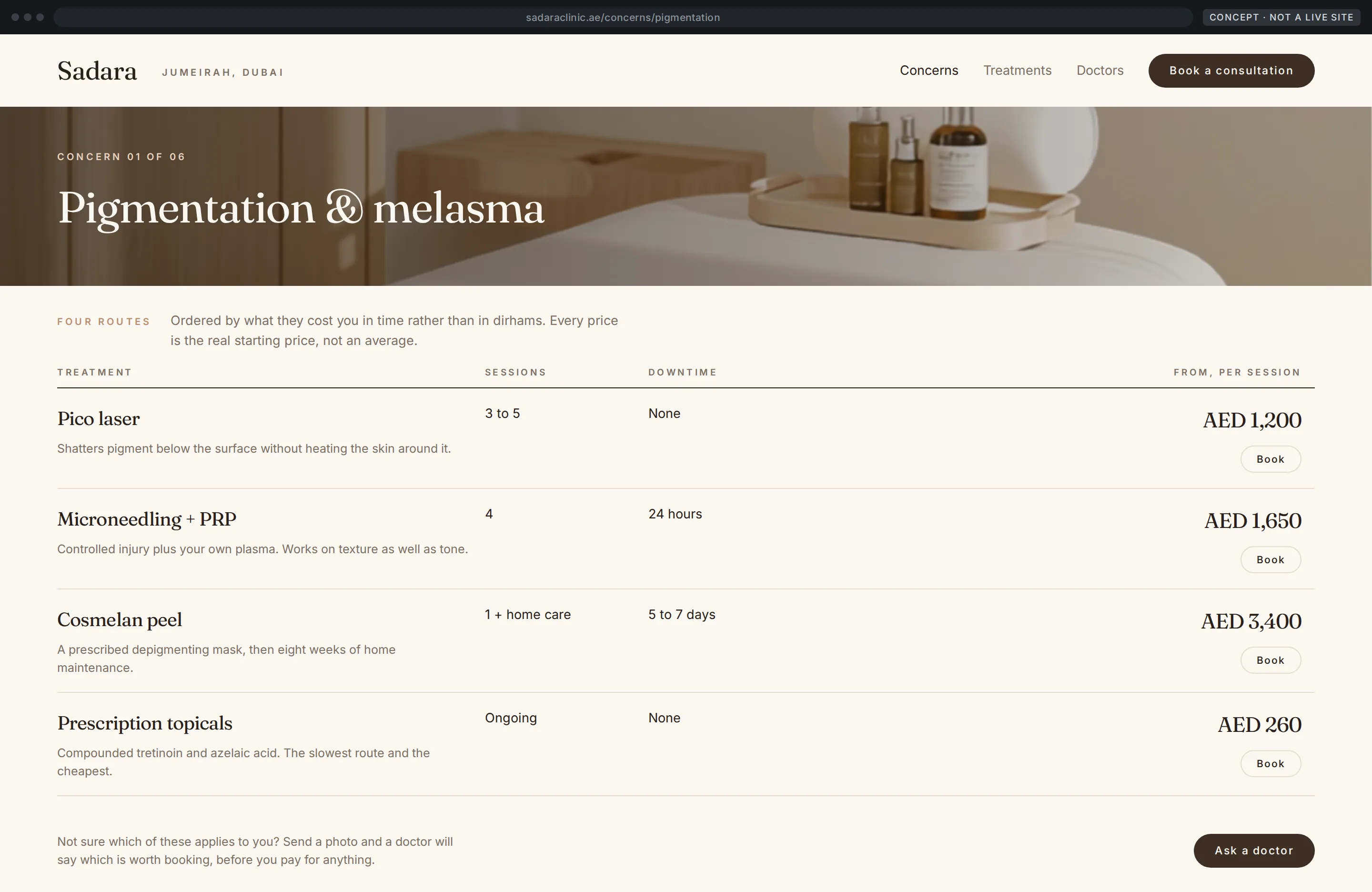
The concern opens with the room again, then four routes as a ruled table rather than a row of cards, each carrying sessions, downtime and a real starting price.
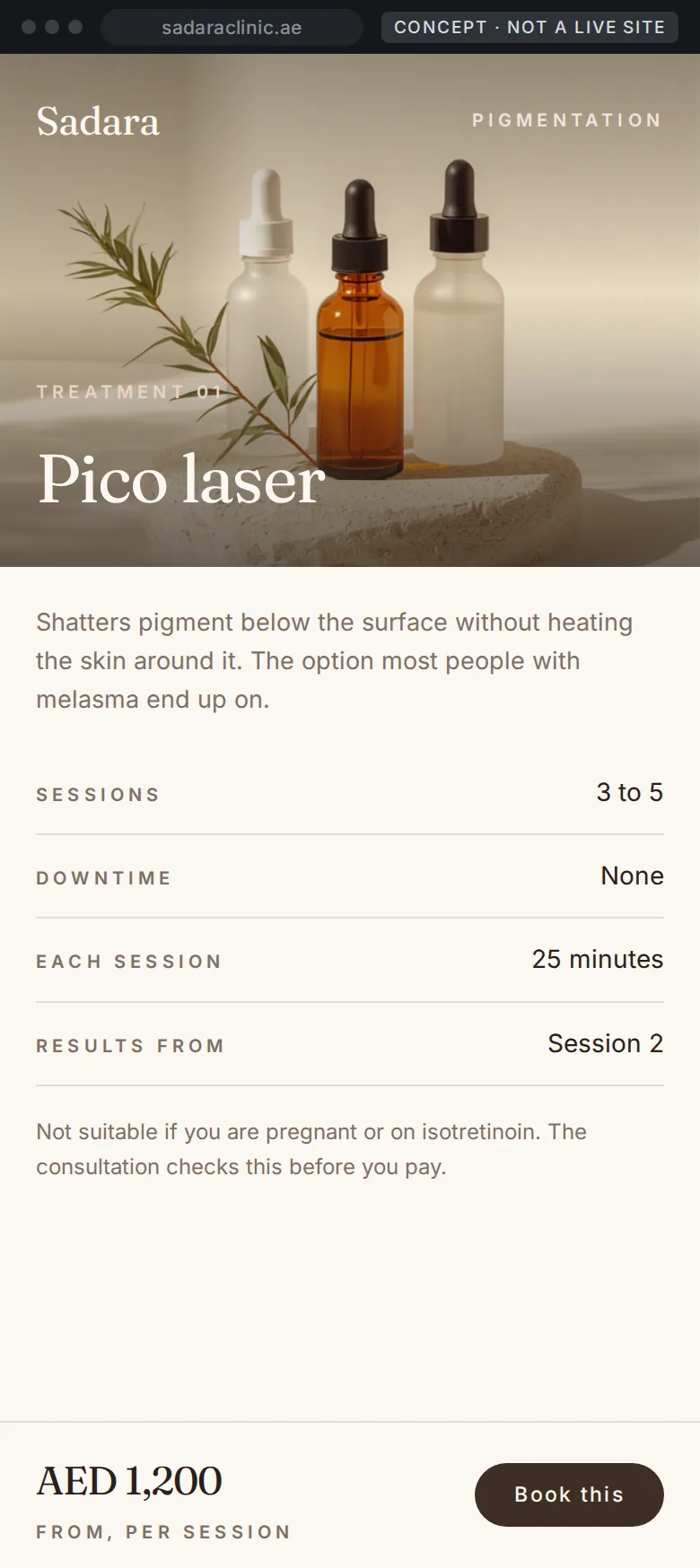
The phone screen opens on the photograph too, with the price and the booking action held at the foot so the decision never scrolls out of reach.
DECISIONS
The three that matter.
Concern is the page, not the filter
Pigmentation gets a URL, a heading and a paragraph of its own. It is what people search, so it is what should rank, and it is where the comparison belongs.
Four facts on every option
Sessions, downtime, who it suits and what it costs. These are the four things that decide a booking, and they appear on the card rather than three clicks in.
The cheapest route is shown too
Prescription topicals sit in the same list as the AED 3,400 peel. A menu that hides its cheap option is a menu people stop trusting.
What this would mean for your site.
A concept for a company this size is only worth publishing if the thinking survives being scaled down. This is the part that does.
- 01Any business with a long service list has this problem in smaller form: a salon menu, a garage, a law firm's practice areas. The list is organised by what the business does rather than by what the customer came in with.
- 02Concern-level pages are what local search reads. Structure built around how people describe their problem is the same work as ranking for how people describe their problem.
- 03Publishing real starting prices is a conversion decision with a measurable answer. It filters enquiries, and whether that costs or saves money shows up in the enquiry data within a quarter.
ABOUT THESE CONCEPTS
Every business in this section is invented. Sadara Clinic, Qamra Barbers and Sabkha Coffee Roasters do not exist and are not stand-ins for clients. Their names, prices, opening hours and locations were created for the exercise. Nothing here is client work, a proposal or evidence of results. Every visible asset was made for this exercise, and no real company identity appears in the designs.
NEXT MOVE
Rather see this thinking on your own site?
Tell us what yours has to do and we'll say where we would start.